Cars and sustainability do not naturally belong in the same sentence. For decades, the private car has symbolized emissions, congestion, and resource consumption. At first glance, combining telematics apps with sustainability may seem like a cosmetic exercise rather than a meaningful contribution – or worse, an example of greenwashing dressed up as innovation.
Mobility is not disappearing. Insurance companies, mobility providers, and drivers still operate in a world where cars remain essential to daily life and economic activity. The real question is no longer whether cars are sustainable. The more relevant question is how driving itself can become more sustainable – through measurable improvements in behavior, efficiency, and everyday mobility decisions.
Cars may not be sustainable by design, but driving can be.
This is where telematics shifts the narrative. Instead of treating cars and sustainability as structural opposites, insurers can use behavioral insight, incentives, and intelligent communication to reduce emissions trip by trip, driver by driver.
The False Opposition: Cars vs. Sustainability
The traditional debate is binary. Cars emit CO₂. Sustainability demands lower emissions. Therefore, cars are the problem.
But this framing ignores two important realities.
First, driving behavior has a measurable impact on emissions. The same vehicle can produce significantly different CO₂ levels depending on speed patterns, acceleration, and trip structure.
Second, insurance telematics is not just about pricing risk. It is about influencing behavior. And behavior is one of the few levers that insurers can realistically activate at scale.
Instead of asking, “Are cars sustainable?”, a more useful question is: “How can we make every trip more sustainable than the last one?”
From Abstract Climate Goals to Measurable Trips
Sustainability discussions often operate at a macro level: fleet averages, regulatory targets, national carbon footprints. Drivers, however, experience mobility at a micro level – one trip at a time.
Telematics makes it possible to translate sustainability into something tangible.
Insurers do not need a long feature list to make sustainability tangible. It is enough to measure emissions per trip, reflect vehicle type, and relate driving style to efficiency in a clear, comparable way.
Every combustion engine has an efficiency sweet spot. Drive well outside it, accelerate aggressively, or brake unnecessarily, and emissions rise. Make that relationship visible and sustainability stops being abstract. It becomes behavioral.
The relationship is not linear. Based on emission models from the German Environment Agency, the same vehicle traveling at 180 kph can produce nearly three times the CO₂ compared to optimal speeds between 50-80 kph. Even manufacturer-stated emissions assume this ideal range—real-world driving behavior routinely adds or deducts up to 20% to or from baseline figures. Telematics makes these deviations visible at the trip level, transforming an abstract efficiency curve into actionable feedback.
Figure: CO₂ emissions by average travel speed, based on PHEM emission modelling (Euro-6 fleet average).
Emission values are derived from adjusted driving cycles provided by the Handbook Emission Factors for Road Transport (HBEFA), as calculated using the Passenger Car and Heavy-Duty Emission Model (PHEM). The three-segment regression model follows Ahn & Rakha (2021). For speeds between 50 and 80 km/h, emissions remain approximately constant at 130 g/km. Above 80 km/h, CO₂ output rises quadratically — at 180 km/h, a vehicle produces nearly three times the emissions compared to the optimal range. The ±20% driving behaviour band illustrates how individual driving style (acceleration patterns, braking, RPM) shifts the entire curve. Use the slider to explore the effect.
The Role of Eco Scores and Simple Symbols
Data alone does not change behavior. Presentation does.
Many drivers do not relate to “grams of CO₂ per kilometer.” It is too technical and too distant from daily life. That is why sustainability in telematics must be translated into intuitive feedback.
An eco score based on driving style can reflect how closely a driver operates within efficient speed ranges and how smoothly they handle the vehicle. This score does not need to expose complex formulas. It simply needs to show: better driving equals lower impact.
For some audiences, even that is too concrete. A symbol can be more powerful than a number.
One to five green leaves. A growing tree. A simple visual progression that reflects sustainable behavior over time.
These proxies make sustainability emotional instead of technical. They shift the focus from “How many grams?” to “How did I do?”
Sustainability Is Also a Messaging Strategy
Technology alone does not reposition an app. Communication does.
A telematics app can feel like a surveillance tool focused purely on risk and claims. Or it can feel like a mobility companion that supports safer and more responsible behavior.
The difference often lies in messaging and marketing automation.
For example:
- Highlighting eco-friendly driving achievements in push notifications
- Framing smooth driving as both safer and more sustainable
- Encouraging alternatives for short trips, such as walking or cycling
- Combining mobility insights with health-oriented messages
If part of the customer journey consistently touches on sustainability, the perception of the entire program shifts.
This does not require exaggerated claims. It requires thoughtful orchestration. Telematics events such as short trips, frequent cold starts, or improved eco scores can trigger communication that nudges behavior in a constructive direction.
How Insurers and Drivers Are Using Telematics for Sustainable Outcomes
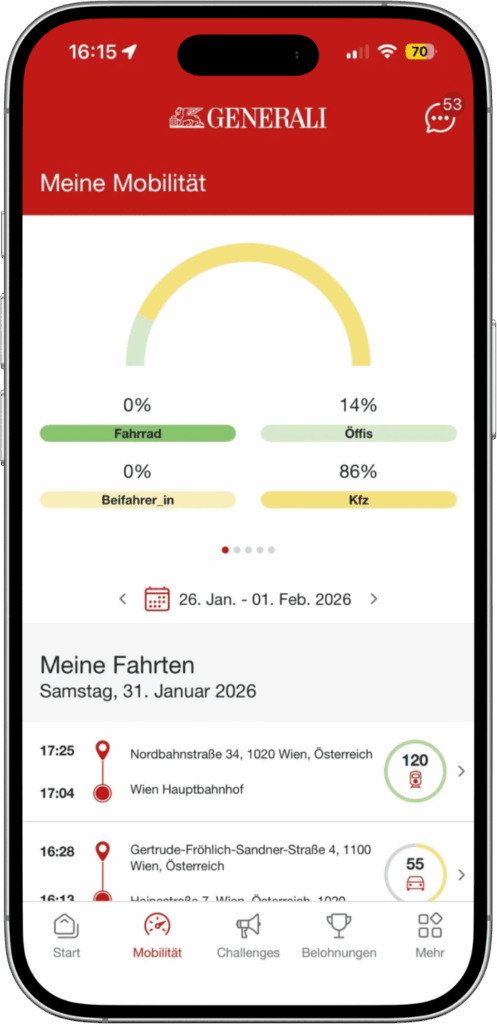
Generali Mobility: Rewarding the Sustainable Mobility Mix
Generali’s Mobility app places the mode-of-transport mix at the center of the user experience. Instead of focusing solely on car trips, the app measures how customers move overall — including public transport, cycling, and car usage as a driver or a passenger.
Sustainable modes such as biking and public transport are actively rewarded with higher scores, such as 120 score points for environmentally friendly trips. By recognizing and incentivizing low-impact mobility choices, Generali extends telematics beyond driving behavior and turns mobility data into a sustainability instrument.
Porsche Smart Driver: Making Sustainability Contextual
The Porsche Smart Driver app translates driving behavior into a clear Green-Score, visualized through intuitive leaf symbols. Instead of abstract CO₂ figures, drivers receive immediate feedback on how sustainable a specific trip was.
Importantly, the score reflects more than driving style. Even a smooth and safe trip can receive a weaker eco rating if it was very short or affected by heavy traffic. By making trip context visible, Porsche turns telematics data into a practical sustainability signal — encouraging more efficient usage patterns and greater awareness of everyday mobility decisions.

Insurers as Sustainability Enablers
Motor insurance operates on narrow technical margins. Traditionally, the business model has focused on pricing risk accurately and settling claims efficiently.
But telematics opens a different dimension. Insurers can:
- Influence driving style
- Reduce accident risk
- Lower fuel consumption
- Contribute to emission reduction
- Promote multimodal mobility
This is not about turning insurers into climate activists. It is about recognizing that safe driving, efficient driving, and sustainable driving are closely aligned.
Fewer harsh accelerations mean fewer accidents and lower fuel consumption. Reduced short trips lower both exposure to risk and emissions. Encouraging walking instead of driving for very short distances improves health and can reduce claims frequency over time.
In this context, sustainability becomes a by-product of better risk management.
A Pragmatic View on Cars and Sustainability
Cars will remain part of mobility ecosystems for the foreseeable future. The transition to electric vehicles will continue, but even electric fleets benefit from efficient driving and thoughtful trip planning.
So what is the answer to the apparent contradiction between cars and sustainability?
The answer is not to deny the environmental impact of mobility. And it is not to label every digital feature as a sustainability initiative. The answer is more pragmatic.
Make driving more sustainable.
Make emissions measurable. Make behavior visible. Make feedback intuitive. Make communication consistent.
Telematics does not solve climate change. But it gives insurers and mobility players a practical lever: behavior. It enables them to reduce emissions trip by trip, encourage smarter mobility decisions, and align safety, efficiency, and sustainability in a single framework.
Cars and sustainability may not be a natural pairing. But driving can become more sustainable when it is measured, understood, and actively influenced.