The rapid spread of COVID-19 in early 2020 confronted governments, health authorities, and businesses with a shared problem: decisions had to be made quickly, but reliable, forward-looking data was scarce. Infection numbers were reported with a delay, testing capacities were limited, and policy measures often relied on retrospective indicators.
At the same time, one factor was already proving decisive in the spread of the virus: human mobility. How often people move, how far they travel, and how consistently mobility patterns change in response to restrictions all directly influence infection dynamics.
At Dolphin Technologies, we applied our experience in large-scale mobility analysis to this challenge. Using anonymized telematics data from tens of thousands of vehicles, we developed a COVID-19 mobility forecast model capable of anticipating infection trends several days in advance – providing an additional decision-support layer during an unprecedented crisis.
Why mobility data matters in a pandemic
Epidemiological models traditionally rely on reported infection numbers, hospitalization rates, and laboratory testing. While essential, these indicators tend to lag behind real-world behavior.
Mobility data offers a complementary perspective. Changes in movement patterns typically occur before changes in infection statistics become visible. Reduced commuting, fewer long-distance trips, and altered daily routines all affect how quickly a virus can spread through a population.
By observing these shifts in near real time, mobility data can act as an early signal – highlighting whether containment measures are likely to take effect or whether infection numbers may continue to rise.
From telematics to epidemiological insight
Dolphin Technologies has long analyzed mobility behavior to understand risk exposure in insurance and transportation contexts. During the COVID-19 outbreak, this same analytical foundation was adapted to a public-health use case.
The COVID-19 mobility forecast model was built on aggregated and anonymized driving behavior data from approximately 30,000 vehicles in Austria. Rather than tracking individuals, the model focused on population-level patterns, such as:
- Overall traffic volume and changes over time
- Average trip length and frequency
- Differences between urban and rural mobility behavior
- Regional variations in movement reduction
These indicators were then correlated with officially reported infection figures, allowing the model to estimate how current mobility behavior would likely translate into infection numbers in the following days.
Predicting trends, not individuals
A critical principle behind the model was privacy by design. No personal movement histories, routes, or identifiers were used. All insights were derived from aggregated data, ensuring that individual drivers could not be identified or traced.
The goal was not to predict who might become infected, but to understand how collective mobility behavior influences infection dynamics at a regional and national level.
This distinction is essential. Forecasting trends enables better preparation and policy evaluation without compromising individual privacy.
Early results and practical use
Initial results showed that changes in mobility behavior could be linked to infection trends approximately one week in advance. When traffic volumes declined significantly, reported infection growth rates tended to slow in the days that followed. Conversely, increases in mobility often preceded renewed growth in case numbers.
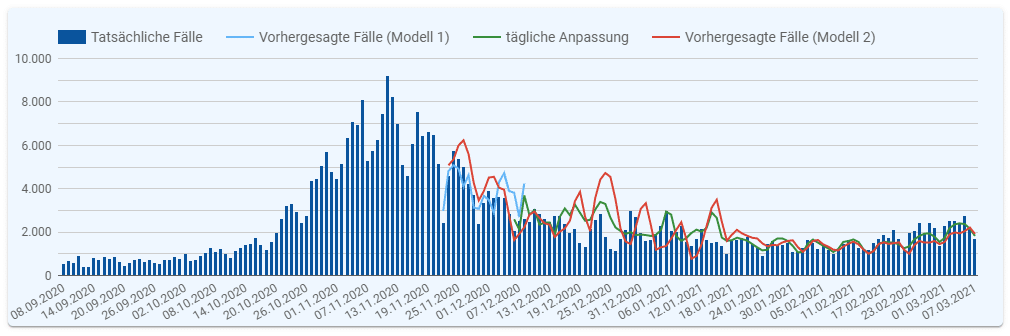
To make these insights accessible, Dolphin Technologies provided a public dashboard visualizing mobility trends alongside forecasted infection developments. In addition, aggregated results were shared with public authorities to support scenario planning and impact assessment of containment measures.
What this means beyond COVID-19
While the immediate application addressed a pandemic, the underlying principle is broader: mobility behavior is a powerful leading indicator for societal risk.
Whether the challenge is road safety, environmental impact, or public health, understanding how people actually move – rather than how we assume they move – enables more proactive and targeted decisions.
For insurers, mobility data already supports risk prevention and exposure analysis. In a crisis context, the same capabilities can help policymakers and institutions respond faster and with greater confidence.
A technology perspective grounded in responsibility
The COVID-19 crisis highlighted both the potential and the responsibility that comes with large-scale data analysis. Dolphin Technologies’ contribution focused on using existing capabilities where they could add immediate, practical value – without introducing new risks or dependencies.
Mobility data alone cannot solve a pandemic. But when combined thoughtfully with epidemiological expertise and public policy, it can provide an earlier window into what may come next.