Not every project is about scale or long-term platforms. Some collaborations matter because they mark a turning point – internally, culturally, or strategically. Dolphin’s 2017 collaboration with Ö3, Austria’s largest radio station, was one of those moments.
At the time, the discussion around road safety was dominated by awareness campaigns and penalties. Everyone knew distracted driving was dangerous, yet behavior on the road barely changed. The Ö3 collaboration emerged from a simple but challenging question: what if we stopped telling people to be careful and instead designed incentives that made safer behavior feel rewarding?
Why Ö3 was the right partner
A crucial part of the collaboration was not just experimentation, but reach. At the time the collaboration launched, Dolphin’s goSmart app – an early consumer app built around rewarding safe driving – already had around 40,000 active users.
Ö3 played a key role in closing the gap between a promising technology and a broad public audience. By promoting goSmart on air, Ö3 helped bring the idea of rewarding safe driving into mainstream conversation, far beyond early adopters or technology-focused users.
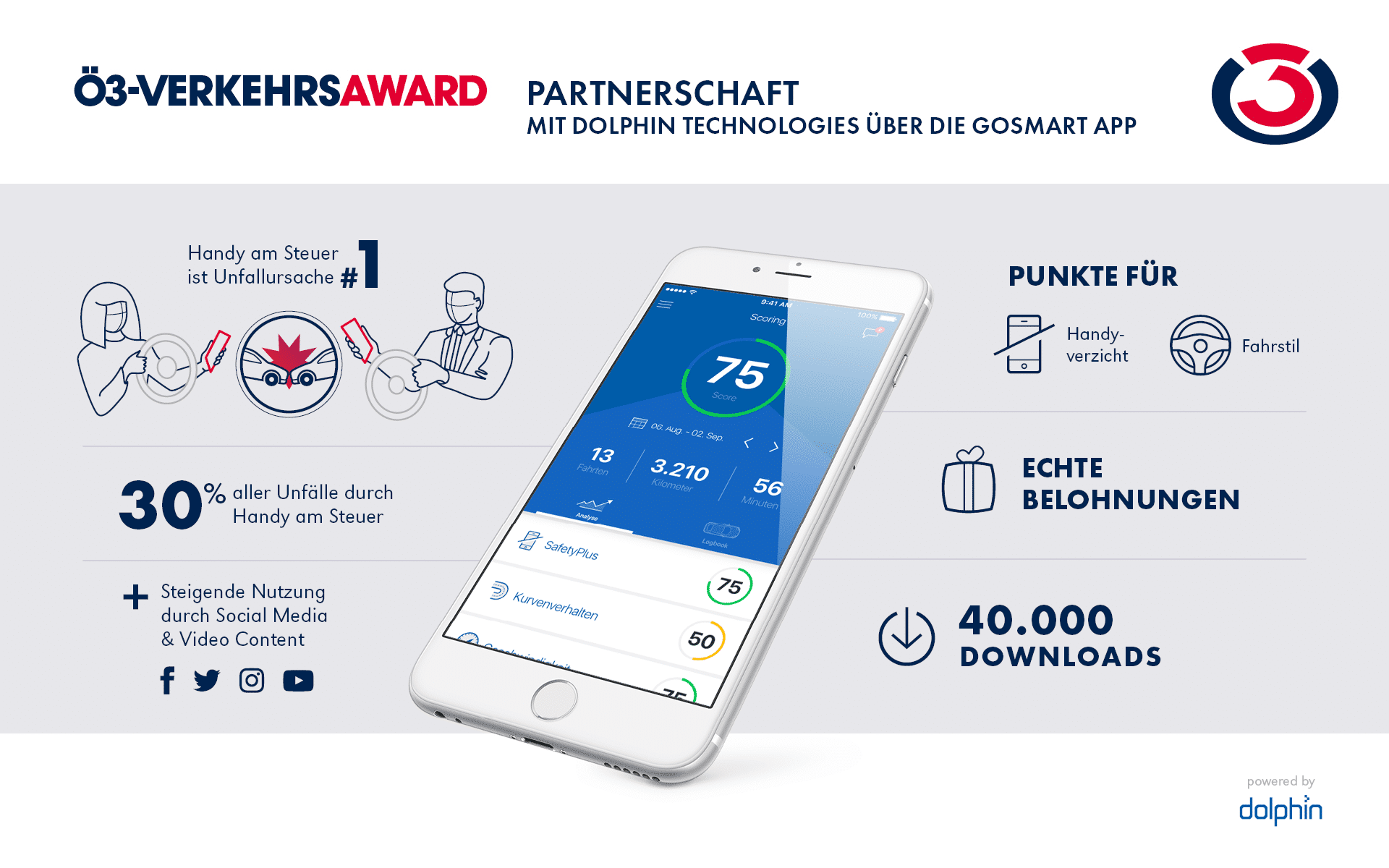
This mattered because goSmart was not positioned as an insurance product. It was a standalone consumer app designed to test whether incentives, feedback, and everyday rewards could influence driving behavior at scale. Ö3’s endorsement gave the concept credibility and visibility at a moment when behavior-based approaches were still unfamiliar to most drivers.
The app itself is no longer available today, but its role as a proving ground was significant. It demonstrated that tens of thousands of drivers were willing to engage voluntarily with a reward-based safety concept – an insight that later shaped how Dolphin approached insurer-backed telematics programs.
Ö3 reaches millions of people every day. As Austria’s biggest radio station, it has a unique position: trusted, familiar, and deeply embedded in everyday life – including time spent in the car.
That made Ö3 a natural partner for exploring road safety beyond traditional campaigns. The goal was not to lecture drivers or amplify fear-based messaging, but to test whether positive reinforcement could influence everyday driving habits at scale.
For Dolphin, this collaboration offered something equally valuable: access to a broad, non-technical audience. If an idea could resonate with Ö3 listeners, it had a chance of working outside insurer-driven telematics programs as well.
From awareness to incentives
The core idea behind the collaboration was deliberately simple. Instead of focusing on violations or penalties, the initiative rewarded drivers for not engaging in one of the most common risk factors on the road: smartphone distraction.
This approach challenged a deeply rooted assumption in road safety – that punishment is the primary lever for change. Behavioral research suggested otherwise: habits are more likely to change when good behavior is acknowledged immediately and consistently.
The Ö3 collaboration allowed Dolphin to test this hypothesis in a real-world setting, outside of underwriting models or insurance contracts.
A concrete feature: detecting and communicating traffic jam dynamics
One of the most tangible features of the Ö3 collaboration was the use of Dolphin’s goSmart app to improve how traffic jams were detected and communicated to drivers.
By aggregating anonymized mobility data from participating users, the app could identify not only the presence of a traffic jam, but also two critical moments that traditional traffic reporting often misses:
- The formation of a traffic jam (where congestion is building)
- The dissolution of a traffic jam (where traffic is starting to flow again)
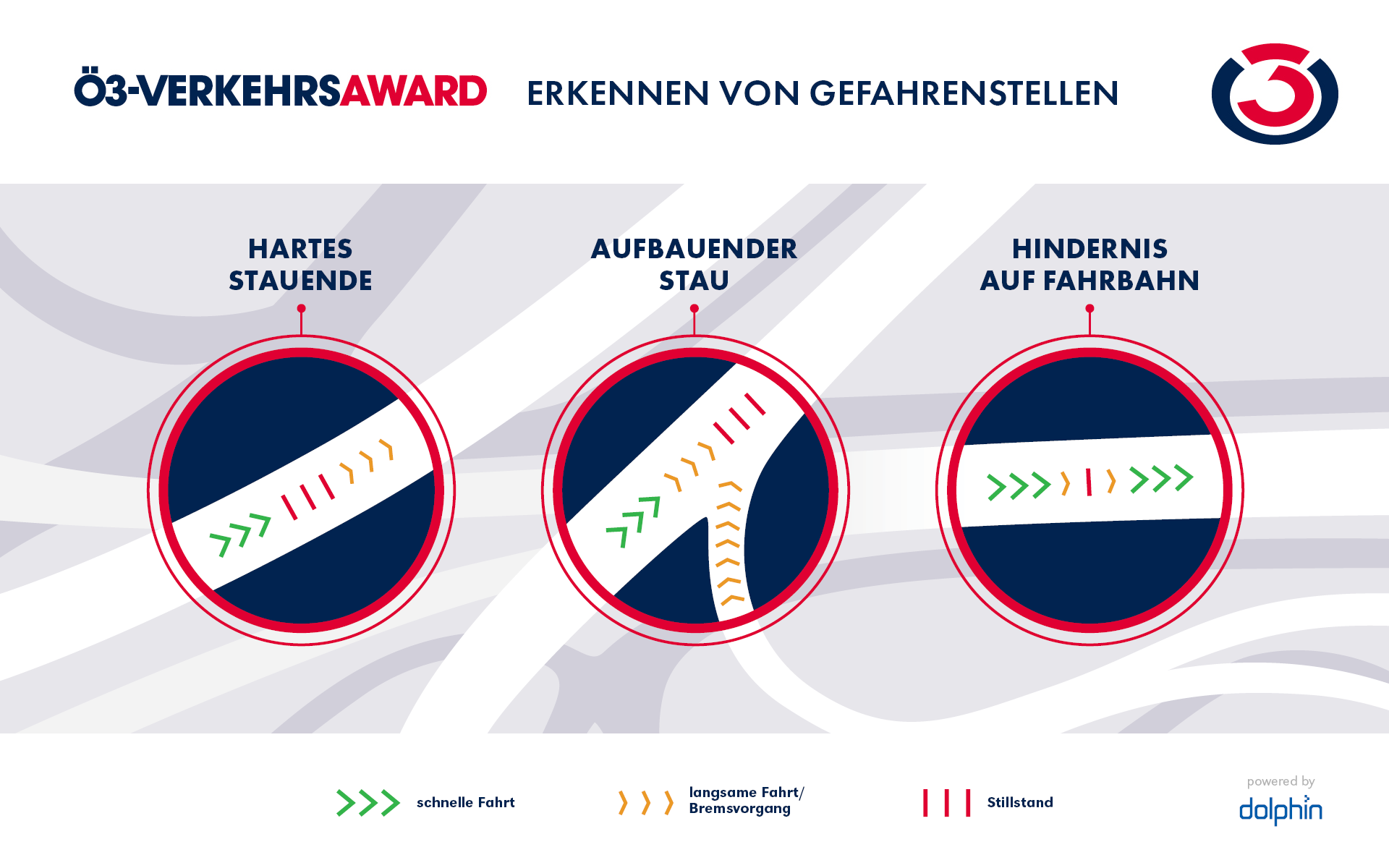
This information was fed into Ö3’s traffic reporting workflows and broadcast via radio in near real time. Instead of static or delayed reports, listeners received more precise alerts about when and where congestion was emerging – or clearing.
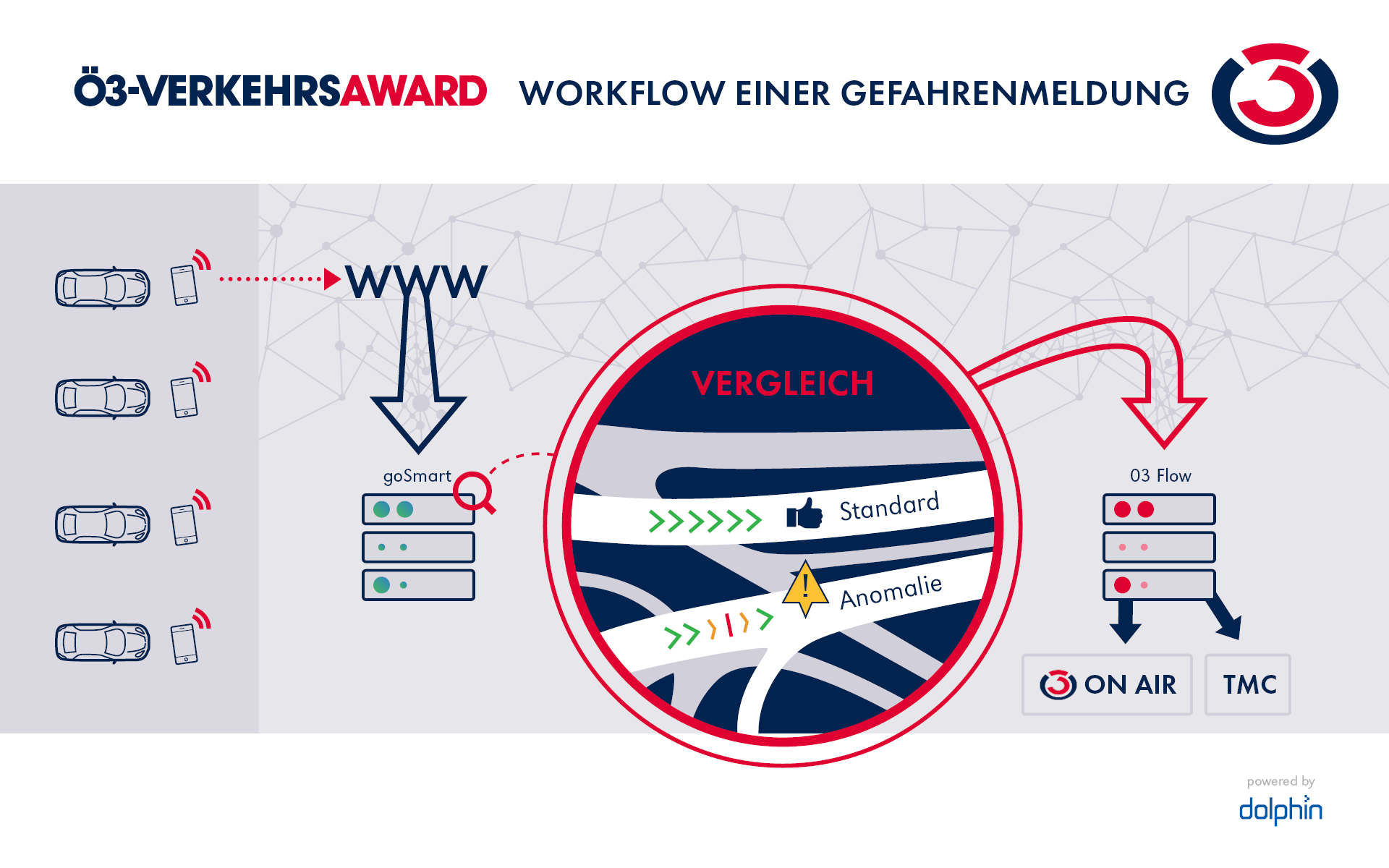
The effect was practical rather than spectacular. Drivers could avoid routes where jams were just forming, reduce unnecessary braking and stop-and-go driving, and adjust their behavior earlier. From a safety perspective, this mattered: smoother traffic flow reduces rear-end collisions, secondary accidents, and stress-driven driving decisions.
Importantly, this feature illustrated a broader principle that later became central to Dolphin’s work: prevention is most effective when information reaches people at the right moment, through channels they already trust.
What we learned from the collaboration
- Awareness alone is not enough
Drivers already know that distracted driving is dangerous. Repeating the message does little to change behavior if the underlying incentives remain unchanged. - Timing matters more than explanations
Feedback and rewards are most effective when they are closely tied to the behavior itself. Delayed consequences – whether fines or abstract warnings – rarely influence moment-to-moment decisions. - Positive reinforcement lowers resistance
Framing road safety around rewards rather than control reduced skepticism and defensiveness. Participants were more open to engaging when the initiative felt supportive rather than judgmental. - Scale introduces realism
Working with a mass-market partner like Ö3 exposed the gap between theoretical models and real-life usage. Not every user is motivated by the same rewards, and simplicity often outperforms sophistication.
How this influenced Dolphin’s later work
The Ö3 collaboration did not become a long-term consumer product, nor was it intended to. Its value lay in what it taught Dolphin about behavior-driven prevention.
Many of the principles explored during that phase later resurfaced in more structured contexts:
- Incentives instead of punishment
- Focus on specific behaviors rather than abstract scores
- Prevention before claims, not after
- Engagement models that respect user autonomy
These ideas became foundational as Dolphin expanded its work with insurers, mobility partners, and telematics platforms.
Why this collaboration still matters
From today’s perspective, the Ö3 project can be seen as an early signal of a broader shift in insurance and mobility: from reactive risk handling to proactive risk reduction.
It demonstrated that safer driving is not just a matter of information or enforcement, but of designing systems that align with how people actually behave. That insight remains just as relevant today – whether applied through insurer apps, risk scores, or contextual warnings.
Looking back, the collaboration with Ö3 was less about technology and more about mindset. It helped crystallize a belief that continues to guide Dolphin’s work: if you want to reduce accidents, you have to work with human behavior, not against it.